From Budget Line Item to Strategic Asset: Rethinking Cybersecurity Talent in the Age of AI
Many organisations are increasing their investment in cybersecurity and AI training—yet are seeing limited impact on real-world capability.
07 May 2026
TL;DR:
AI adoption is accelerating faster than workforce readiness
Corporate training is not translating into real capability
Cyber risk is increasingly driven by AI, fraud, and human gaps
Organisations must shift from training delivery → capability building
Structured, role-based pathways are key to closing the gap
Why Corporate Training Is Struggling to Keep Up
Many organisations are increasing their investment in cybersecurity and AI training—yet are seeing limited impact on real-world capability.
Tools are being deployed. Courses are being completed. But workforce readiness is not keeping pace with the speed of change.
This disconnect is becoming more visible as organisations face a new reality: cyber threats are no longer just evolving—they are accelerating through AI.
Recent reporting in Cyber defenders urged to use AI to counter AI threats highlights how organisations in Singapore are being urged to adopt AI-enabled defence as cyber threats become increasingly automated and scalable (The Straits Times, 2026).
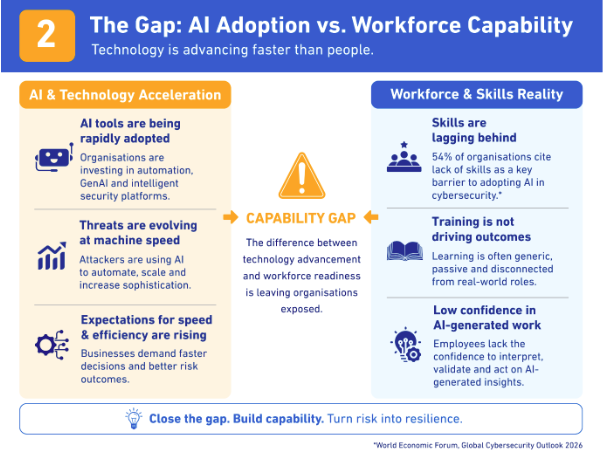
At the same time, global data reinforces this gap. According to the Global Cybersecurity Outlook 2026, 54% of organisations cite a lack of skills as a key barrier to adopting AI in cybersecurity, while many still require human validation of AI-generated outputs—highlighting a disconnect between technology adoption and workforce capability (World Economic Forum, 2026).
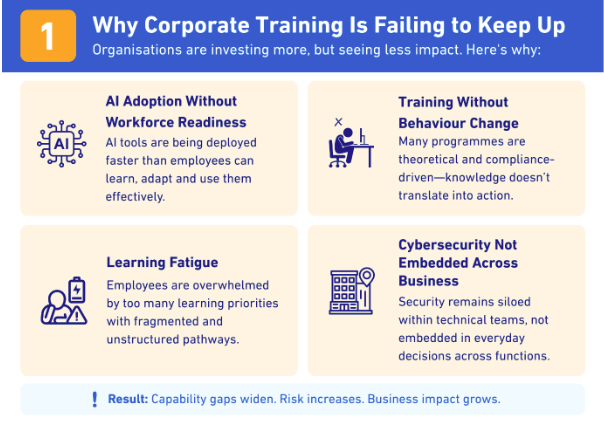
The Real Problem: Training Is Not Translating into Capability
The issue is no longer a lack of training investment—it is a lack of effective outcomes.
AI Adoption Without Workforce Readiness
Organisations are rolling out AI tools across security operations, but employees lack the skills to use them effectively.
AI is now the top driver of cybersecurity change, yet workforce capability has not kept pace (World Economic Forum, 2026).
Result:
Tools are underutilised
Risk visibility remains limited
ROI on AI investments is unclear
Training Exists — But Behaviour Doesn’t Change
Many programmes remain:
Compliance-driven
Theoretical
Detached from real-world scenarios
This aligns with insights from CompTIA, which highlight that workforce proficiency continues to lag behind rapid technology adoption (CompTIA, 2025).
Employees may complete training—but:
Cannot apply it in real incidents
Cannot interpret AI outputs effectively
Cannot make informed risk decisions
Learning Fatigue Is Slowing Progress
Employees are expected to continuously upskill in:
AI
Cybersecurity
Digital tools
But without structured pathways, learning becomes fragmented and ineffective.
Cybersecurity Is Still Not Embedded Across the Business
Cybersecurity remains siloed within technical teams, despite increasing enterprise-wide exposure.
Yet modern environments require:
Cross-functional awareness
Business-aligned risk understanding
In Singapore, this shift is reflected in national initiatives led by Infocomm Media Development Authority and the Cyber Security Agency of Singapore, which emphasise workforce capability development in both AI and cybersecurity (IMDA, 2025; CSA, 2025).
Build Capability That Matches Business Needs
Explore how leading organisations are addressing AI and cybersecurity capability gaps through structured, role-based learning pathways.
👉Browse ITEL’s full course catalogue to identify role-based training pathways tailored to your organisation
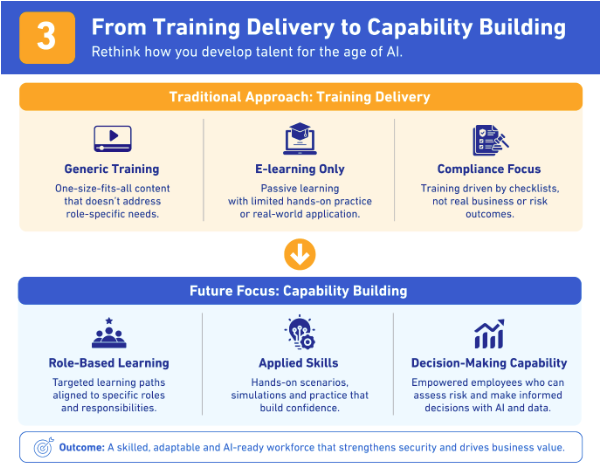
The Shift: From Training Delivery to Capability Building
To address these gaps, organisations must rethink how they approach workforce development.
This is not about more training.
It is about building capability that translates into action.
From Generic Training to Role-Based Learning
Different roles require different capabilities:
SOC analysts → detection and response
Managers → risk interpretation
Executives → decision-making
Structured certification pathways from organisations such as EC-Council help align training with real-world responsibilities (EC-Council, 2026).
Explore Industry-Aligned Training Pathways
Discover structured programmes aligned to certifications from EC-Council, CompTIA, Microsoft, and PeopleCert—designed for practical, real-world application.
From E-Learning to Applied Skills
Self-paced learning alone is insufficient.
Effective training must include:
Scenario-based exercises
Discussion-driven learning
Real-world application
Frameworks from PeopleCert emphasise structured capability development that integrates knowledge with practice (PeopleCert, 2025).
From Hiring Talent to Building Talent
The traditional model:
👉 Hire experienced professionals
The emerging reality:
👉 Build internal capability
As highlighted in Gartner’s Top 10 Strategic Technology Trends for 2026, organisations are shifting towards smaller, AI-augmented teams, increasing the importance of upskilling existing employees (Gartner, 2026).
In Singapore, this aligns with broader workforce transformation efforts led by Infocomm Media Development Authority and Cyber Security Agency of Singapore (IMDA, 2025; CSA, 2025).
Organisations are also placing greater emphasis on adaptability and long-term capability development rather than relying solely on hiring experienced talent. This mirrors broader workforce trends highlighted by Singapore cybersecurity leaders, including the need to cultivate problem-solving and AI-ready skills early in talent pipelines (Channel NewsAsia, 2026).
Accelerate Workforce Transformation with Funded Training
Organisations in Singapore can leverage funded programmes to strengthen internal cybersecurity and AI capabilities more sustainably.
🔗 View Funded Courses
From Technical Skills to AI-Augmented Decision Making
Modern cybersecurity roles now require:
AI literacy
Critical thinking
Risk-based decision-making
Microsoft highlights the emergence of hybrid work models where humans collaborate with AI systems—requiring new skill sets beyond technical execution (Microsoft, 2025).
This shift is increasingly reflected in Singapore’s industry landscape. Leaders from ST Engineering have highlighted how cybersecurity professionals must evolve alongside AI-enabled operations, requiring continuous upskilling and stronger interdisciplinary capabilities (Channel NewsAsia, 2026).
What High-Performing Organisations Are Doing Differently
Organisations closing the capability gap are not necessarily spending more—they are spending differently.
They are :
Aligning training with business outcomes
Embedding learning into workflows
Prioritising role-based capability development
Investing in structured certification pathways
Combining AI tools with human expertise
A Practical Framework for Corporate Training Leaders
To move from cost centre → strategic asset, organisations should focus on:
1. Define Capability Outcomes
What should employees be able to do—not just know?
2. Align Training to Roles
Map learning to specific job functions.
3. Integrate AI Literacy
Ensure employees can interpret and validate AI outputs.
4. Measure Impact
Track:
Response time
Decision quality
Risk reduction
5. Build Continuous Learning Pathways
Move beyond one-off courses towards structured progression.
The Bottom Line
Corporate training is not failing because of lack of investment.
It is failing because it has not adapted to how work has changed.
In an environment where:
AI is reshaping threats
Cyber risk is accelerating
Workforce expectations are evolving
Organisations that treat training as a strategic capability lever—rather than a compliance exercise—will be better positioned to respond.
Final Thought
Cybersecurity talent is no longer just a budget line item.
It is a strategic asset—one that determines how effectively organisations can navigate risk, adopt AI, and sustain growth in an increasingly complex digital landscape.
Build Cybersecurity Capability That Delivers Real Outcomes
If your organisation is rethinking how to develop AI-ready cybersecurity talent, the next step is to move beyond generic training towards structured capability building.
ITEL partners with organisations to design and deliver role-based learning pathways aligned to industry certifications and real-world workforce requirements.
Explore programmes tailored for your team:
Browse Course Catalogue
Or discover funded training options available:
View Funded Courses
References
Channel NewsAsia. (2026, May 4). Cyber talent harder to find as AI reshapes threat landscape.
CompTIA. (2025). Workforce and AI skills insights.
Cyber Security Agency of Singapore. (2025). Cybersecurity capability development initiatives.
EC-Council. (2026). Certification and workforce readiness frameworks.
Gartner. (2026). Top 10 strategic technology trends for 2026.
Infocomm Media Development Authority. (2025). Digital workforce and AI skills development initiatives.
Microsoft. (2025). Work trend index: Human–AI collaboration models.
PeopleCert. (2025). ITIL capability and service management frameworks.
The Straits Times. (2026, March 3). Cyber defenders urged to use AI to counter AI threats.
World Economic Forum. (2026). Global cybersecurity outlook 2026.
To learn more about the IT industry, contact us today.
Contact usGet the latest news and insights and stay up-to-date with ITEL
Recent articles
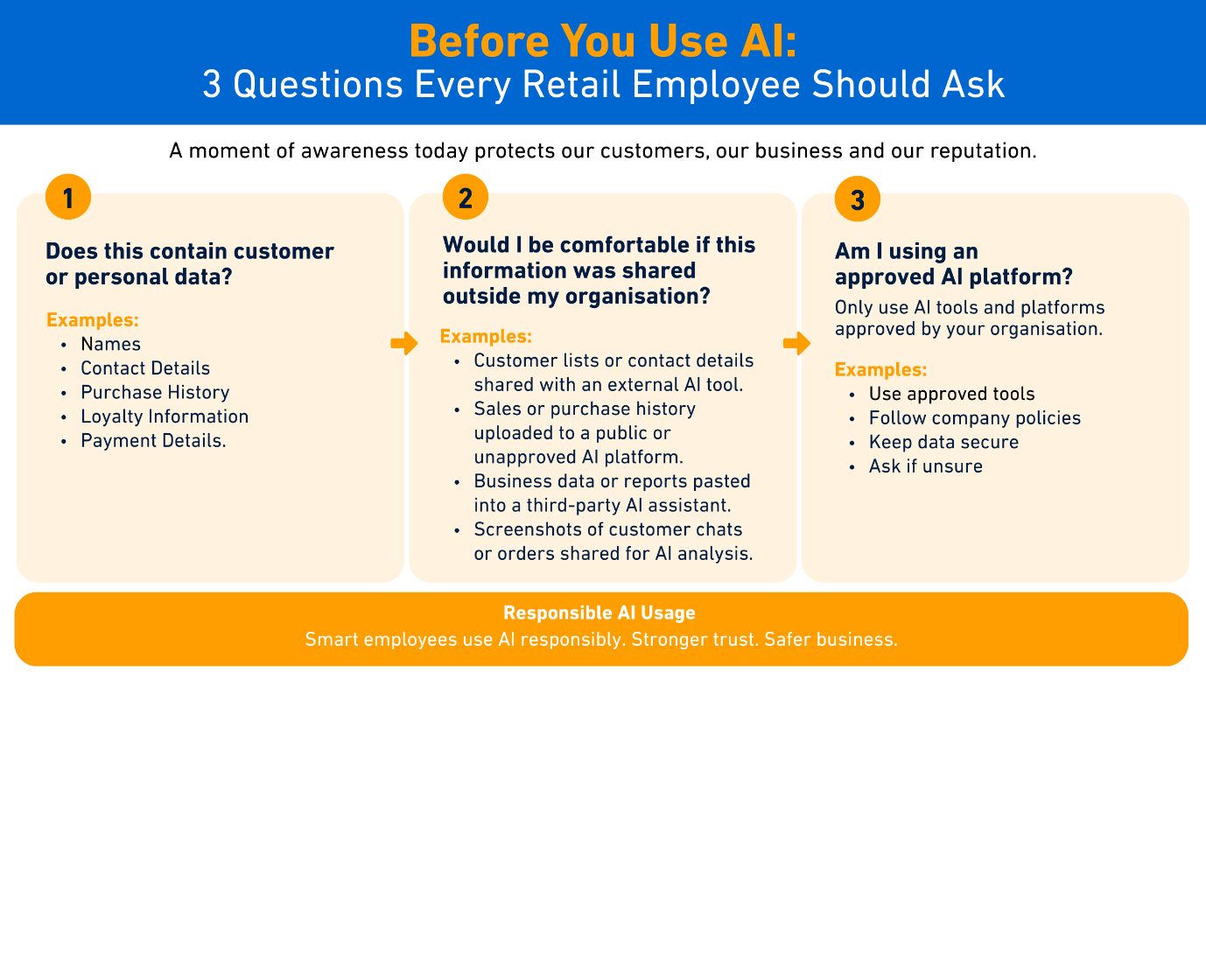
AI and Security in Retail & eCommerce: What Singapore Businesses Need to Prepare for in 2026
Retail and eCommerce businesses face increasing pressure to deliver faster, more personalised, and seamless customer experiences. Consumers today expect: Personalised recommendations, Faster customer support, Omnichannel shopping experiences, Efficient order fulfilment.
Read article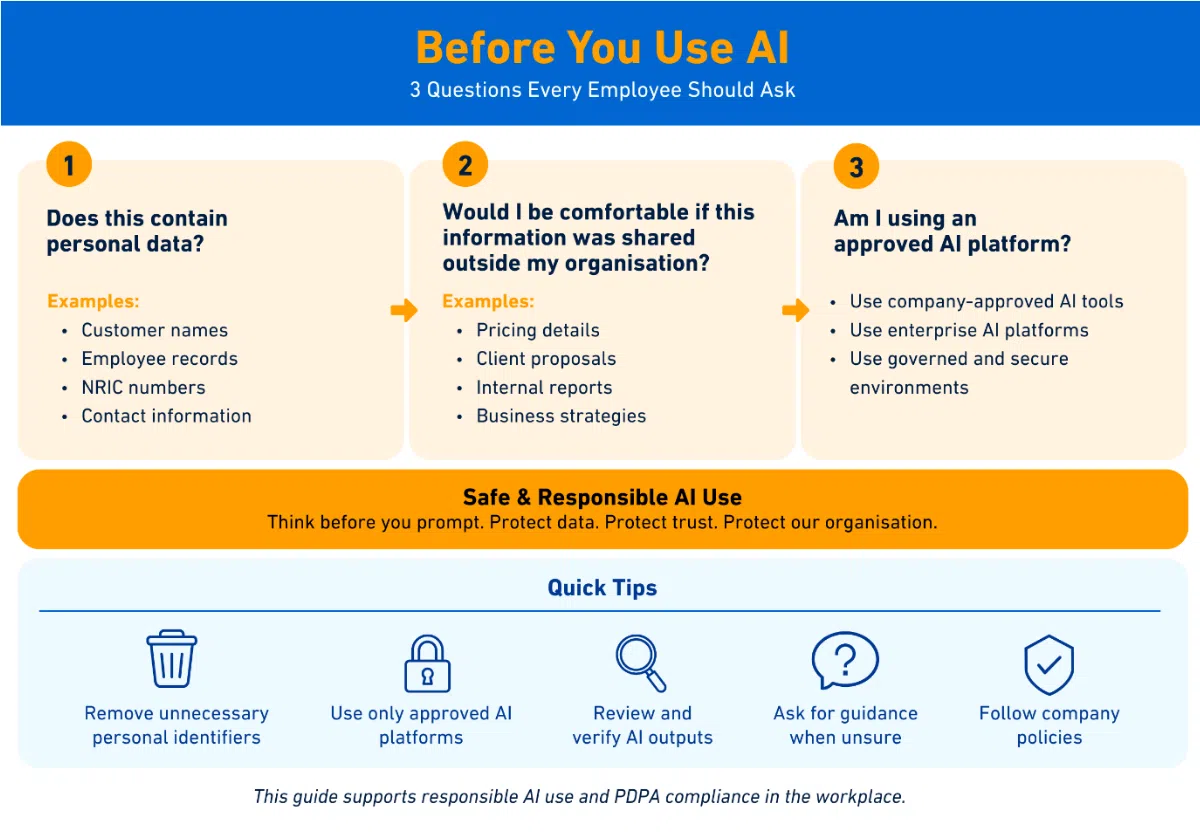
PDPA and AI in Singapore: What Every Employee Needs to Know in 2026
As AI tools become part of everyday work, organisations face growing concerns about personal data protection and responsible AI use. Learn how PDPA applies when employees use AI tools and what organisations should do to reduce risk.
Read article