AI
AI and Security in Retail & eCommerce: What Singapore Businesses Need to Prepare for in 2026
Retail and eCommerce businesses face increasing pressure to deliver faster, more personalised, and seamless customer experiences. Consumers today expect: Personalised recommendations, Faster customer support, Omnichannel shopping experiences, Efficient order fulfilment.
03 Jul 2026
TL;DR
• AI is transforming retail and eCommerce operations across Singapore.
• Retailers increasingly use AI for customer service, marketing, inventory planning, and business analytics.
• Greater AI adoption also introduces new challenges around customer data protection, AI governance, and workforce awareness.
• Customer trust is becoming a key competitive advantage as organisations collect and process more customer information.
• Organisations that invest in AI literacy, governance, and responsible AI adoption will be better positioned to scale AI successfully.
Why AI Adoption Is Accelerating Across Retail and eCommerce
Retail and eCommerce businesses face increasing pressure to deliver faster, more personalised, and seamless customer experiences.
Consumers today expect:
• Personalised recommendations
• Faster customer support
• Omnichannel shopping experiences
• Efficient order fulfilment
At the same time, organisations continue to manage rising operational costs, labour shortages, and increasing competition.
Artificial Intelligence (AI) is helping retailers address these challenges by improving efficiency, enhancing customer engagement, and supporting data-driven decision-making.
Across Singapore, AI is increasingly being used to:
• Improve customer service
• Optimise marketing campaigns
• Forecast demand more accurately
• Enhance inventory planning
• Analyse customer behaviour
For many organisations, the conversation is no longer about whether to adopt AI, but how to do so effectively and responsibly.
Where Retailers Are Using AI Today
Customer Service
AI-powered chatbots and virtual assistants are helping organisations handle routine enquiries, improve response times, and provide round-the-clock support.
Marketing and Personalisation
Retailers are using AI to segment customer audiences, personalise promotions, generate content, and improve campaign performance.
Inventory Management
AI helps organisations forecast demand, reduce stock shortages, optimise inventory levels, and improve supply-chain planning.
Business Analytics
AI can process large volumes of customer and operational data, helping managers identify trends and make faster business decisions.
The Growing Security Challenge
As AI adoption increases, so does the volume of customer and business data being processed.
Retailers and eCommerce businesses often handle:
• Customer names
• Contact details
• Purchase histories
• Loyalty programme information
• Payment-related data
This information has significant business value, making retail organisations attractive targets for cybercriminals.
Recent incidents have reinforced the importance of customer data protection. In April 2026, Booking.com disclosed that unauthorised parties may have accessed customer booking information following suspicious activity affecting a number of reservations. While the incident occurred in the travel sector, it serves as a reminder that any organisation handling large volumes of customer information can become a target.
For retail and eCommerce organisations, the challenge is not simply deploying AI tools. It is ensuring AI adoption is supported by responsible data practices, governance, and workforce awareness.
Customer Trust Is Becoming a Competitive Advantage
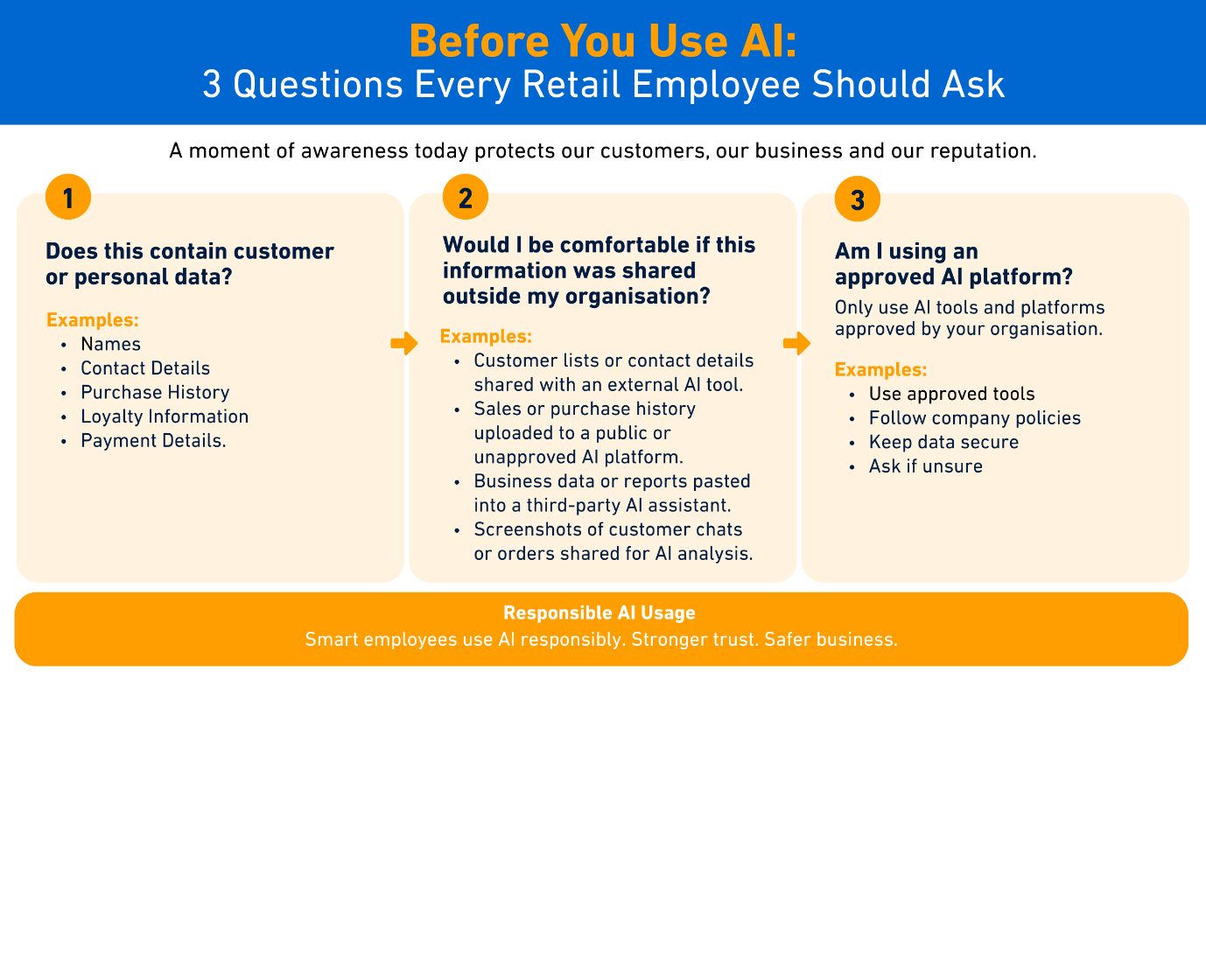
Customers are becoming increasingly aware of how organisations collect and use their information.
Questions such as the following are becoming more common:
• How is my data being used?
• Who has access to my information?
• Is my information protected?
• How are AI systems making decisions?
Organisations that demonstrate transparency, accountability, and responsible AI use are more likely to build long-term customer trust.
In an increasingly competitive marketplace, trust can become a significant business differentiator. Our article PDPA and AI in Singapore: What Every Employee Needs to Know in 2026 explores practical considerations for employees and managers.
AI Governance Matters More Than Ever
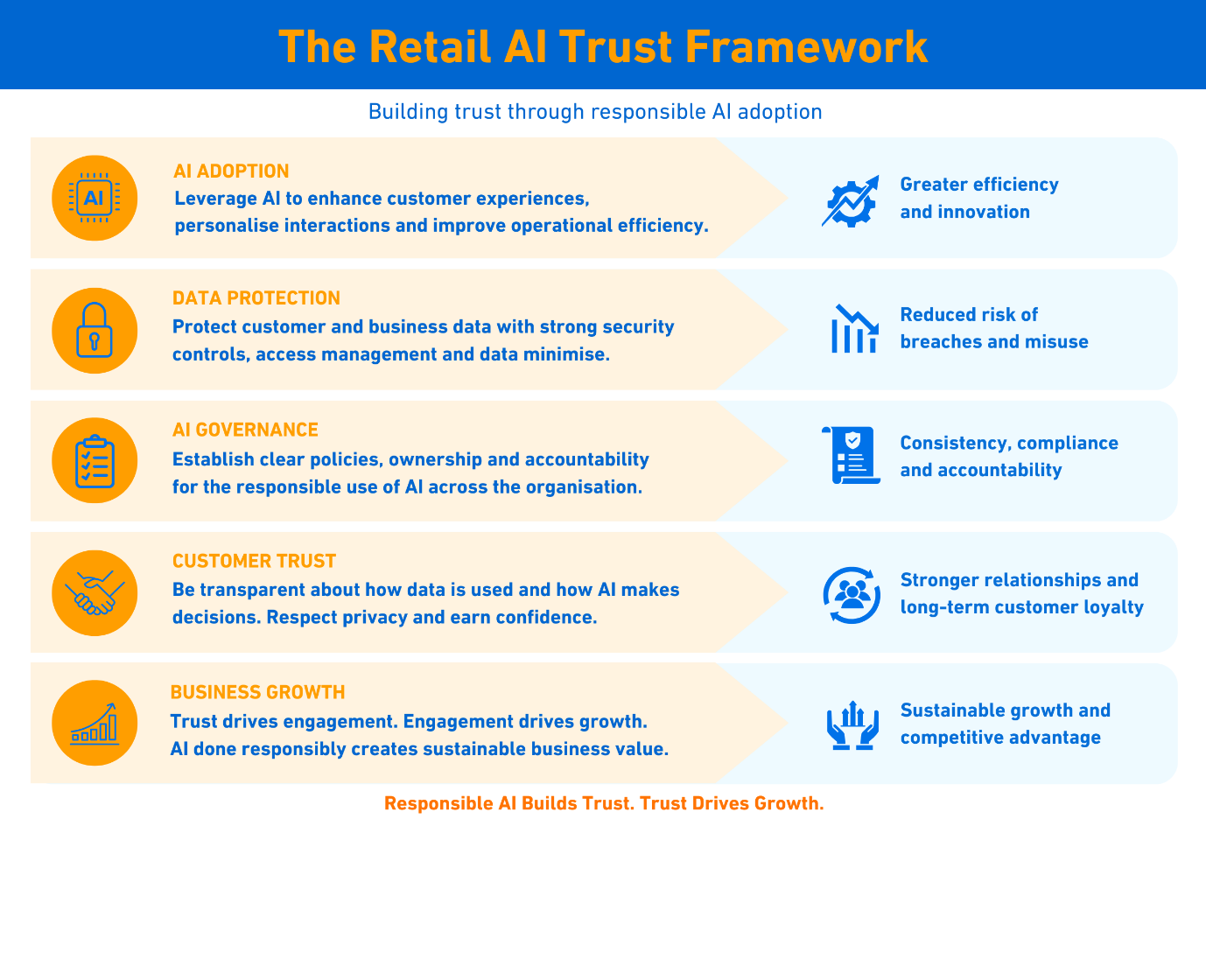
Many organisations have invested in AI tools but have yet to establish clear governance frameworks.
Common challenges include:
• Unclear ownership
• Limited workforce awareness
• Inconsistent AI usage practices
• Lack of accountability
• Unmanaged operational risks
Without proper governance, organisations may struggle to protect customer information, manage AI-related risks, and maintain trust.
This is why AI governance is increasingly becoming a business issue rather than purely a technology issue.
How Retail Leaders Can Scale AI Successfully
Many organisations successfully launch AI pilots but struggle to scale them across the business.
Common barriers include:
• Unclear business objectives
• Limited workforce readiness
• Governance gaps
• Poor change management
• Difficulty demonstrating ROI
Successful AI adoption requires more than technology.
It requires leadership alignment, workforce capability, governance, and continuous learning.
Practical Steps Retailers Can Take Today
Business Leaders
• Identify high-value AI use cases
• Define governance ownership
• Establish AI usage guidelines
Managers
• Encourage responsible AI adoption
• Build AI awareness within teams
• Monitor operational impact and outcomes
Employees
• Follow approved AI usage policies
• Protect customer information
• Verify AI-generated outputs before use
Small improvements in workforce awareness can significantly improve AI adoption outcomes.
Recommended Learning Pathways
For retail managers, operations managers, customer experience leaders, and department heads seeking a practical understanding of AI opportunities, risks, and business applications.
Microsoft Copilot for Business Productivity
For managers and teams looking to improve productivity through AI-assisted reporting, content creation, meeting summaries, data analysis, and workflow efficiency.
MS-4022: Extend Microsoft 365 Copilot in Copilot Studio
For digital transformation leads, IT managers and innovation teams looking to build and extend AI copilots for business workflows.
Conclusion
AI is transforming the retail and eCommerce landscape.
From customer service and marketing to inventory planning and business analytics, AI offers significant opportunities to improve efficiency and customer experiences.
However, successful adoption requires more than technology.
It also requires:
• Workforce readiness
• Responsible governance
• Customer trust
• Security awareness
• Organisational accountability
Organisations that invest in AI literacy, governance, and workforce capability today will be better positioned to compete in Singapore's increasingly AI-driven economy.
The goal is not simply to adopt AI.
It is to adopt AI responsibly and effectively.
References
Booking.com. (2026). Customer notification regarding suspicious activity affecting reservations.
Infocomm Media Development Authority (IMDA). (2026). Model AI Governance Framework for Agentic AI.
Personal Data Protection Commission Singapore (PDPC). (2026). Guidance on personal data protection and AI governance.
The Straits Times. (2026, April). Customer data potentially exposed following Booking.com security incident.
World Economic Forum. (2026). AI at Work: From Productivity Hacks to Organisational Transformation.
World Economic Forum. (2026). Future of Jobs Report 2026.
To learn more about the IT industry, contact us today.
Contact usGet the latest news and insights and stay up-to-date with ITEL
Recent articles
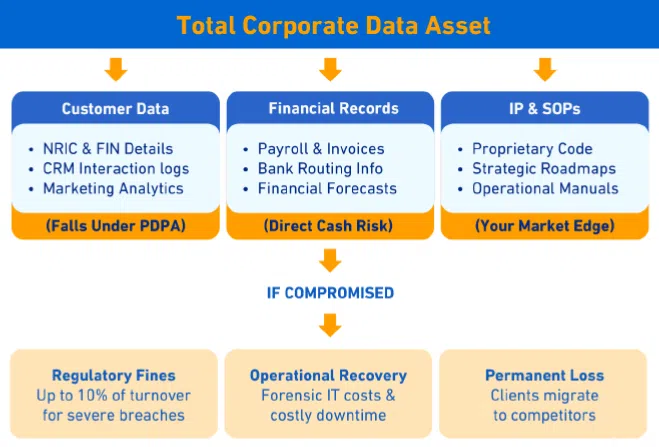
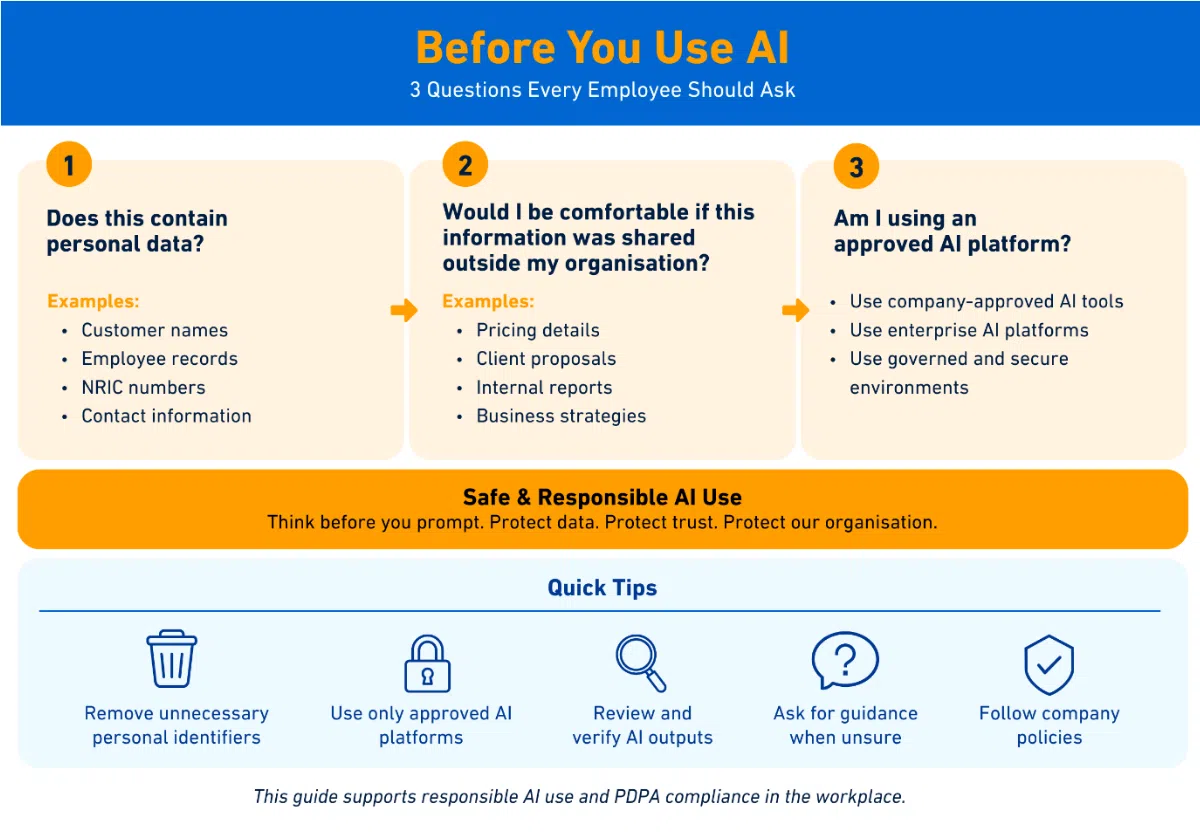
PDPA and AI in Singapore: What Every Employee Needs to Know in 2026
As AI tools become part of everyday work, organisations face growing concerns about personal data protection and responsible AI use. Learn how PDPA applies when employees use AI tools and what organisations should do to reduce risk.
Read articleAgentic AI for Smart Manufacturing: Enabling Industry 5.0
Discover how Agentic AI is shaping the next generation of Smart Manufacturing in Singapore and why workforce readiness, governance, and operational transformation matter for Industry 5.0.
Read article